



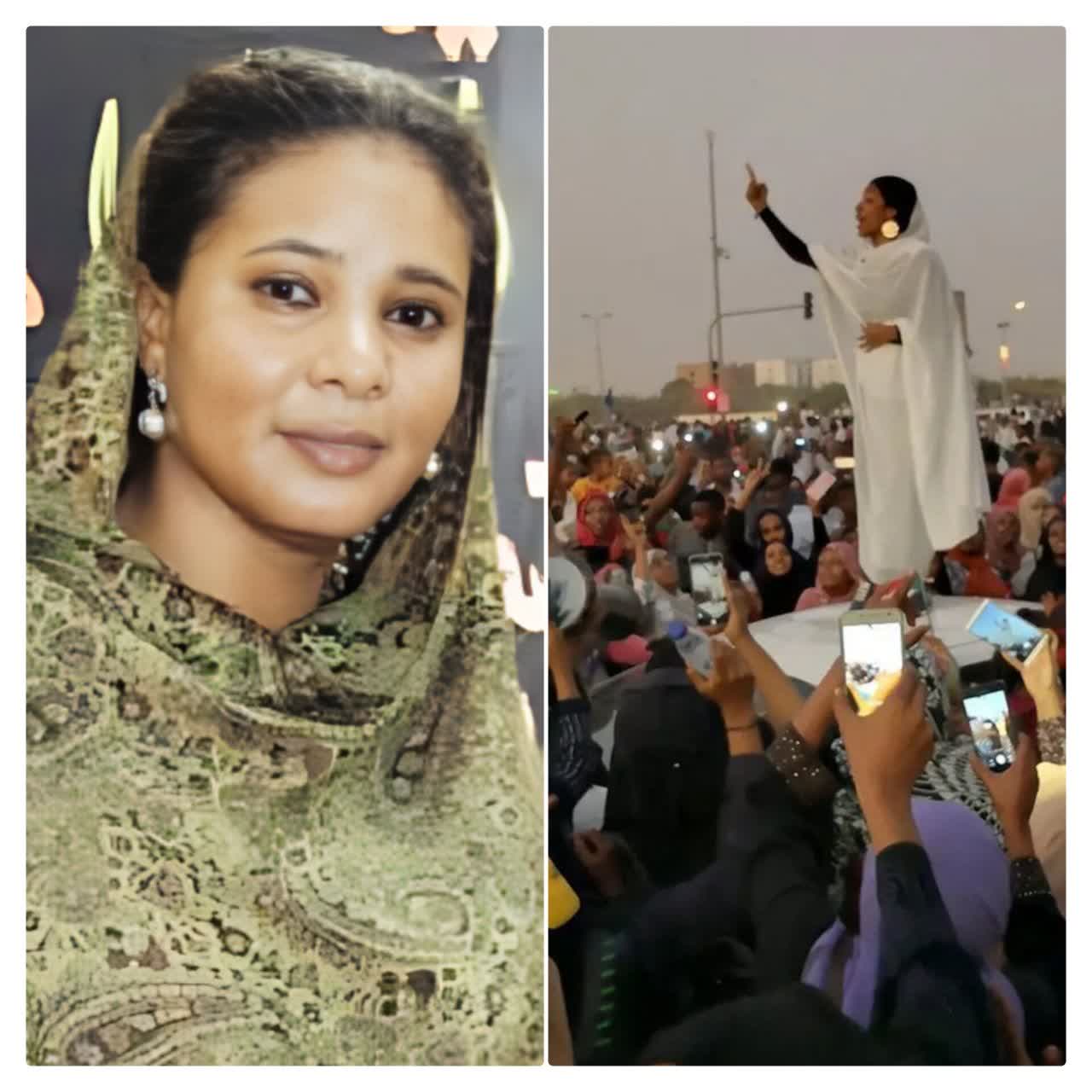
As the world watches in shock at the brutality sweeping Sudan — where Emirati-Israeli-backed forces have targeted women and children — the image of Alaa Salah has become a social-media trend. Clad entirely in white and standing atop a car, she sings “al-thawra, al-thawra…” (“the revolution, the revolution…”), claiming the struggle against religious tyranny in her country.
✍|by Ms. Maryam Ordouei
The Early Sparks: From Arrests to Global Attention
Alaa Salah did not emerge as a symbol of Sudanese women’s resistance overnight. The movement’s roots trace back to Lubna Ahmed al-Hussein, arrested for “improper dress” and fined 146 pounds or sentenced to a month in jail. Lubna reached out to media and human-rights groups, inviting hundreds to attend her court hearing.
Her case gained international attention, leading to her participation in the Oslo Freedom Forum in Sweden. Supported by Amnesty International, she published her book, Forty Whiplashes for Trousers, drawing global attention to Sudanese women’s struggle. This momentum helped establish the “No to the Oppression of Women” campaign as a global trend.
Amira Osman and the Challenge to Public Order Laws
The push to abolish Sudan’s hijab law continued with Amira Osman Hamed in 2013, arrested for appearing in public without a headscarf. Her case brought international scrutiny to Sudan’s public order laws.
The Strategic Initiative for Women in the Horn of Africa, under the banner of defending women’s rights and promoting gender equality across Africa, called for an immediate reform of Sudan’s public order laws and used the media to drum up support for the abolition of the hijab law.
Alaa Salah and the 2018–2019 Revolution
By 2018, amid economic crisis and protests over fuel subsidy cuts, Alaa Salah emerged as a symbol of women’s resistance against Omar al-Bashir. Her image — standing in white atop a car, leading chants for revolution — circulated worldwide.
She gained a platform at the United Nations Security Council and addressed international bodies, including MANSAM, the coalition of Sudanese civil society organisations. Ultimately, Bashir fell in 2019 under combined domestic and international pressure.
Repeal of the Hijab Law and Political Shifts
Following Bashir’s ouster, Sudan’s transitional government:
- Abolished the hijab/public order law.
- Legalised alcohol consumption.
- Recognised same-sex relationships.
In 2021, Alaa Salah’s book, Revolution’s Song: Sudan’s Uprising as Told by Its Icon, was published. The transitional government also began normalising relations with Israel, culminating in official steps toward reconciliation by early 2023. That same year, Alaa received the Hillary Rodham Clinton Award for Women, Peace and Security.
The Unfinished Struggle for Women’s Rights
Despite Bashir’s fall, Sudanese women still face systemic oppression. Feminist activist Saeeda Yousuf told Le Monde:
“We were at the forefront of overthrowing the Bashir regime; but we are the first victims of the backlash.”
The struggle of yesterday’s Alaa Salahs for removing the headscarf has become today’s horror of women’s heads being slashed by the sharp blade of UAE-backed tyranny. Those beheaded faces speak volumes for our times.