



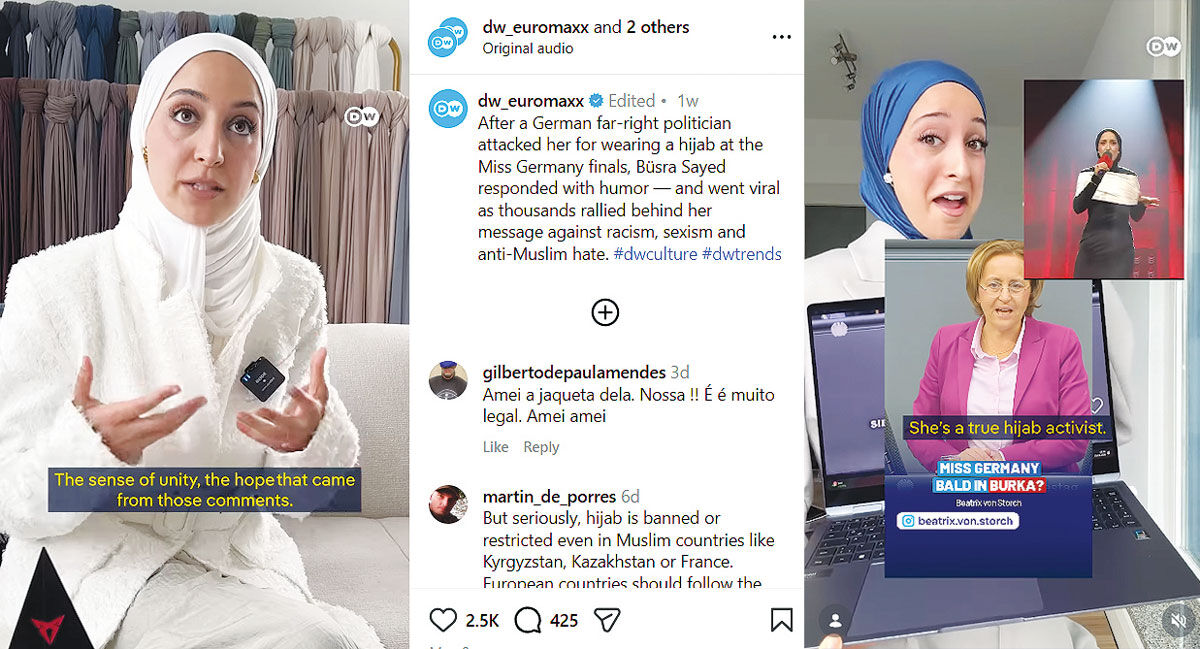
When a German-based Islamic fashion entrepreneur entered the Miss Germany pageant wearing a hijab, she sparked a national debate. But instead of engaging in a political fight, she used humor and marketing savvy to turn a political attack into a viral moment of empowerment.
The Historic Moment
The story began when Busra Sayed, an entrepreneur active in the Islamic fashion sector in Germany, decided to enter the “Miss Germany” competition to promote her products. On the day of the pageant, her appearance on stage wearing an Islamic hijab created a historic moment.
The Council of European Muslims, via their Instagram account (@eumuslims_org), highlighted the significance of her action: “Busra Sayed was the first woman in the history of these competitions to wear a Muslim headscarf.”
The Dangerous Void
However, the story didn’t end with just being the “first.” The incident quickly gained traction on social media. Thousands of users supported her action, viewing it as a symbol of the fight against racism, gender discrimination, and Islamophobia.
The situation escalated when Frau von Storch, a German politician from the right-wing AfD party, brought the issue to the German Parliament. She criticized the decision to allow a Muslim woman to participate in the final round of the Miss Germany pageant to advertise her products. She added, “If such an Islamic activist participating in the final of the Miss Germany competition is considered progress, then we are living in a void—and a very dangerous one at that!”
The AfD (Alternative for Germany) is a right-wing, anti-immigration party that has gained significant influence in German politics since 2015, coinciding with the European migration crisis. The party holds hardline positions against mass migration, the growing influence of Islam, multiculturalism, and the immigration-friendly policies of German governments. Critics accuse the party of fostering anti-immigrant and anti-Muslim sentiment by promoting cultural and economic fear-mongering.
While party leaders typically deny these accusations, claiming to defend “German national identity,” Frau von Storch’s protest against the hijab-wearing participant was rooted in this extreme nationalism. She viewed the presence of a Muslim woman as a sign of the Islamization of German society, stating, “Wherever there is a hijab, jihadists are not far behind… Busra Sayed is not just an active figure in the fashion sector; she is an activist and promoter of the hijab!”
Did You Forget the Discount Code?
Since Busra Sayed was not a political figure, she chose not to make a political statement in response to Frau von Storch’s comments. Instead, she opted to respond with intelligence and humor on social media.
She posted a video on Instagram, saying, “My new friend from the AfD party advertised my brand in parliament for the first time, so please be kind to her!” In the video, she played clips of the politician’s harsh words and added with a laugh, “This politician forgot to announce the discount code.” She then played more of von Storch’s speech and jokingly announced the discount code “AfD10” for purchasing her scarves and headscarves, adding that the code even applied to products in blue (the symbolic color of the AfD party).
Busra’s clever and witty video response went viral, garnering millions of views in a short time. It became a prime example of “soft media response” against political attacks. Most social media users saw her reaction as a successful conversion of a political attack into a media opportunity.
Even some non-Muslim users wrote that they purchased from her brand simply to show solidarity. German media reported that some of her products, including scarves and headscarves in a color jokingly dubbed “AfD Blue,” sold out quickly.
Tabnak noted that Busra Sayed’s media strategy was built on a specific point: transforming the role of “victim of political attack” into an “active media actor.” Instead of entering a direct ideological debate, she tried to turn the tense atmosphere into a humorous and shareable space on social media. This approach not only kept her out of a defensive position but also largely shifted the narrative in her favor.
An Identity Crisis
In interviews following the viral success of her video, Busra Sayed mentioned that while she had experienced everyday racist encounters before, the volume of attacks and hate messages against her increased significantly after her participation in Miss Germany.
She noted that she was asked repeatedly whether a hijab-wearing woman could truly represent a “German woman.” She views this question as a sign of an identity crisis within a segment of German society.
This incident, however, also presented a new image of the new generation of Muslim women in Europe. Unlike older stereotypes, this generation is not merely in a defensive position. They strive to present a different narrative of European Muslim identity by using media tools, humor, personal branding, and active presence in public spaces.
From a political perspective, the Busra Sayed case showed that the issue of hijab in Europe is no longer just about clothing. It has become linked to national identity, migration, cultural integration, and the future of multicultural societies.
For the right-wing stream, the hijab is seen as a symbol of cultural divide and a threat to Western secular values. Meanwhile, for defenders of cultural diversity, banning or excluding hijab-wearing women means limiting individual freedoms and excluding a segment of citizens from public space.
Ultimately, Busra Sayed transformed from a beauty pageant finalist into a media figure in one of Germany’s most controversial cultural and political disputes. She is a personality who, through a smart combination of humor, marketing, and media activism, managed to turn a political attack by a right-wing party into an opportunity for visibility and strengthening her personal brand.
From: qudsonline