




In the alleys of history, sometimes names pass by quietly and silently; they neither shout nor push themselves forward, yet we see their distinct footprints in the most crucial twists of fate-shaping history. Umm al-Banin (peace be upon her) is one of those names; a virtuous, mystic, and poetic lady, whose image, although summarized for many of us for years as the mother of four martyrs, the truth of her being is much deeper, broader, and more influential than this repetitive image.
It is enough to slightly draw aside the curtain of history for the face of a woman to appear who was not just a mother, but a teacher, a manager, and a role model for a correct understanding of responsibility and the position of being a wife and conscious obedience to the Imam of her time.
The narrative of her life, from the very beginning, carries the flavor of a great choice. The day when Ali ibn Abi Talib (peace be upon him), after the bitter years of losing Fatimah al-Zahra (peace be upon her), entrusted his brother ‘Aqeel to choose a worthy wife for him from a lineage of courage, destiny steered his path towards Fatimah bint Hizam al-Kilabiyyah (known as Umm al-Banin).
But in this, it was not only the choice of Ali (peace be upon him) that shaped the future; Fatimah’s choice was also important. From the moment she entered the house of Imamate, she knew that this union was not merely a marriage; it was a mission for which she had to prepare her entire being. Perhaps at that very moment, in her feminine silence, she had understood that one day, in the heart of a great event, her name would also be inscribed alongside the greatest names.
However, what distinguishes Umm al-Banin from many other women is the astonishing insight she showed in managing emotions and her position in the family of Ali (peace be upon him). From the first day, she knew that this house was not only her house; it is the house of light, the legacy of Fatimah al-Zahra (peace be upon her). Therefore, she not only did not position herself as a rival to that lady, but she did not even allow herself to be called ‘Fatimah’ lest a new cloud of sorrow settle even for a moment in the hearts of Hasan and Husayn (peace be upon them).
It is narrated: One day, the Commander of the Faithful (peace be upon him) went to her and found Umm al-Banin (peace be upon her) grieved and sorrowful. When he asked her the reason for her sadness, the lady, in response, requested the Imam to remove the name ‘Fatimah’ from her and not to call her by this name anymore.
When the Commander of the Faithful (peace be upon him) asked the reason for this request, Umm al-Banin (peace be upon her) said: “I have come to this house to serve your children, not to take the place of their mother.” At this point, the Imam (peace be upon him) said to her: “Rather, you are Umm al-Banin (Mother of the Sons).” The lady said to the Commander of the Faithful (peace be upon him): “Master, I have no son (that you have given me this name)!!” The Imam said: “God will grant you.” This was not just a gentle maternal humility; it was a conscious and deep decision to preserve the tranquility of a house where two future Imams were breathing. Perhaps it was this very behavior that forever cemented Umm al-Banin’s love in the hearts of the children of the Prophet.
In the embrace of such a mother, four valiant young men were raised: ‘Abbas, ‘Abdullah, Ja’far, and ‘Uthman. Four sons, four banners of a generation that was to display the authority of faith and sincerity in an unparalleled scene like Karbala. Raising these youths was not the work of chance and fate; Umm al-Binin had taught them the lesson of sacrifice years before Ashura. She told them that true love finds meaning in supporting the Imam of their time. The greatness of ‘Abbas (peace be upon him) in Karbala, his obedience, his gaze, his honor, were part of the legacy of a mother who had insight and saw the future; a mother who knew for what day her children were created.
But the peak of the story of Umm al-Banin’s life was written in the days after Ashura; when Medina was dusted with bitter news and people came to her in groups to offer condolences. It is narrated that when she heard the news of her sons’ martyrdom, she would weep but was calm; only one question was important to her: “Tell me about Husayn; what happened to Husayn?” And when she heard that Imam Husayn (peace be upon him) was also martyred, then her patience collapsed. This simple question is maternal in appearance, but in essence, it expresses a deep understanding of the position of the Imamate and the importance of the axis of the uprising of Ashura. She had understood that with the loss of the Imam of her time, a divine truth had been attacked, and this loss was heavier than the loss of her children.

In the years that followed, Umm al-Banin was not only a mourner; she was a narrator. Her elegies, her accounts, her tears, all turned into a precious document for recounting Ashura. She was the voice of grieving women and mothers, but beyond that, she was the voice of truth; a truth that did not allow the memory of Karbala to be lost in the uproar of politics and power. She knew that Karbala was not merely a historical event; it is a school that must be transmitted from generation to generation.
All of this presents a new face of Umm al-Binin before our eyes. A lady who, although standing on the margins of history, her role-playing is seen in the heart of all the great events of her era. She was not only the mother of martyrs; she was a woman of insight who recognized her responsibility; a manager who administered the house of Imamate with wisdom; a strategist who prepared her children for the greatest test of history; and a woman who, after all sorrows, remained a messenger of truth.
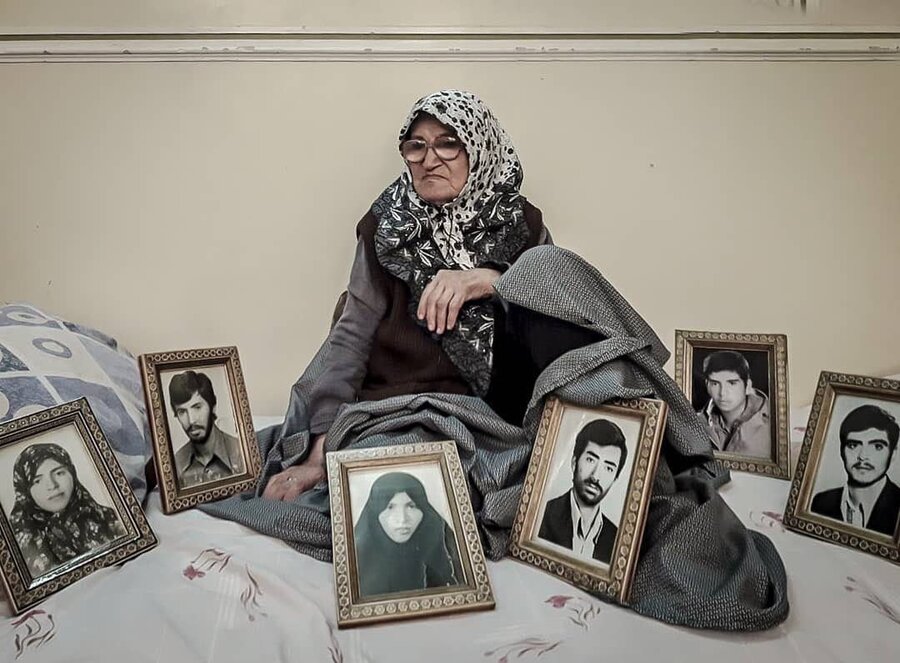
Her passing away reminds us that sometimes the greatest role models are those whose names are not lost in shouts; and they live on in whispers. Lady Umm al-Banin is one of them; a lady whose dignity and recognition shine in deep silence. Lady Umm al-Banin is a radiant lamp for the mothers of martyrs; a mother who bore the loss of her four sons in her heart, but considered the greater loss to be the loss of the Imam of her time. She taught all mothers of martyrs how, under the shadow of guardianship (Wilayah), love can be nurtured and children can be raised who, with their luminous souls, illuminate history.
Faezeh Aghamohammadi