



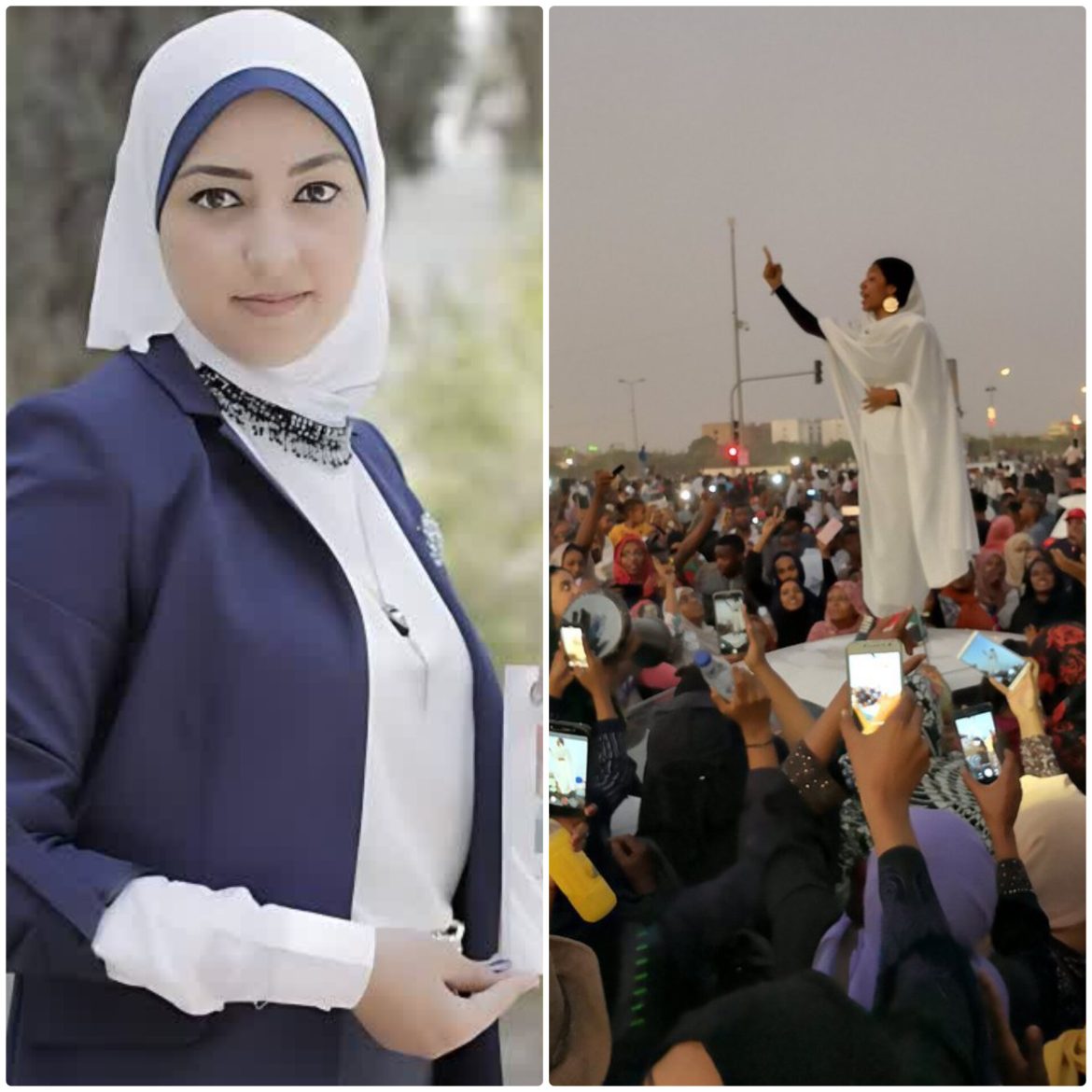
Throughout history, women have emerged who, in their own ways, redefine what it means to be a woman, free, and devoted to their homeland. Sometimes, however, two women sharing the same name—but from different times and places—come to represent opposite directions in history: one builds through truth, the other destroys from the roots.
✍|by Ms. Mahta Sanei
A Reflection on Womanhood, Homeland, and Truth
This is the story of two contemporary women: Alaa al-Qatrawi, the Palestinian poet and teacher from Gaza, and Alaa Salah, the young Sudanese woman who became the symbol of Sudan’s protests.
Alaa al-Qatrawi: Poet of Resistance
Alaa al-Qatrawi is a woman born of pain and resistance. She is a poet who turned her words into weapons and a mother who cherished life within every line she wrote. Holding a PhD in Arabic literature, she published her first poetry collection in 2012. She was not only an educator in the classroom but also a teacher of steadfastness in life.
Despite family responsibilities, she never laid down her pen in the pursuit of truth. She received numerous awards, including the Palestine Youth Creativity Award.
Yet fate had a cruel turn in store. In December 2023, her home in eastern Khan Younis came under Israeli siege. Her children—a son, a daughter, and infant twins—were trapped for days without food or shelter. Only one short call emerged from the heart of fear and destruction, followed by a heavy silence. Months later, news arrived that her home had been destroyed and her children lay under the rubble.
Even after losing everything, Alaa al-Qatrawi did not lose her faith in her homeland. Her name remains etched in the collective memory of Palestinians—not only as a grieving mother but as the chronicler of Gaza’s epic. Her words continue to stand tall, even amidst the ruins.
Alaa Salah: The Face of Revolution
On the other side stands Alaa Salah, a Sudanese student of engineering and architecture in Khartoum, who became a media figure during Sudan’s protests. A photograph of her standing on the roof of a car, chanting slogans, went viral worldwide.
Some of her slogans, like “In the name of religion, they burned us”, went beyond calls for freedom, reflecting a rejection of Sudanese traditions and faith. They appeared to cry for liberation, yet at their core, they challenged the historical and cultural bonds of her nation. Western media hailed her as a “goddess of freedom,” but in reality, she followed a path that, intentionally or not, undermined history and left the identity and values of Sudanese women largely untouched.
Two Women, One Name, Divergent Paths
Both women are brave and active, yet their historical paths diverge profoundly.
- Alaa Salah chose passion over wisdom, writing her history in the fire of a protest without deep roots.
- Alaa al-Qatrawi, in the fire of siege and loss, turned her understanding into a flame of hope, signing her history with blood and poetry.
If history is a path between destruction and creation, Alaa al-Qatrawi undoubtedly chose the path of building: constructing the meaning of womanhood, faith, and homeland. In the silence of her destroyed home, she kept the true cry of history alive.
The Final Question: Which Side of History Are We On?
Which side of history do we stand on? The one that burns to watch, or the one that burns to build?
Perhaps the answer lies in a single sentence:
A true woman is the one who grows history from the soil of her homeland, not the one who turns history into ashes.
